
There are some learning experiences that do not end with the closing ceremony.
They continue quietly.
They stay in your mind during ordinary working days. They return during business decisions. They shape the way you read the news. They change the way you understand your own role.
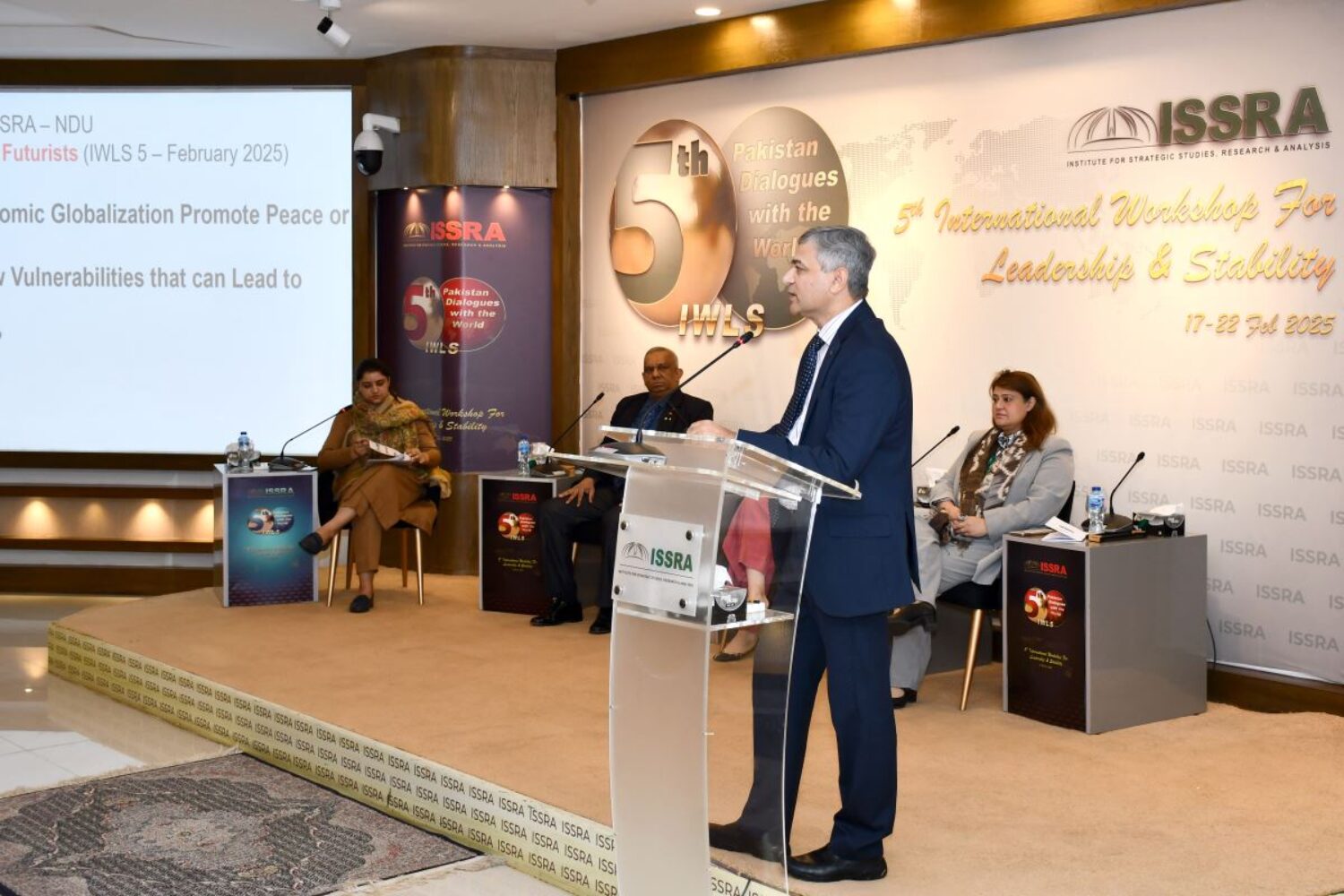
My participation in the 5th International Workshop for Leadership and Stability at National Defence University, Islamabad was one of those experiences.
At the time, I went to NDU as a founder, entrepreneur and innovation professional. My work is mostly rooted in technology, traceability, healthcare, food safety, compliance, serialization and digital trust. I spend most of my time thinking about products, teams, customers, regulations, supply chains and execution.
 But IWLS placed me in a very different kind of room.
It was a room where the language was not only business. It was also security, diplomacy, national interest, regional stability, economic resilience, media, culture, technology, policy and leadership.
That setting forced me to think beyond the immediate world of entrepreneurship.
It made me ask a larger question:
What is the role of an entrepreneur in a country’s broader journey toward resilience, trust and stability?
Seeing security through a wider lens
Before IWLS, like many people outside the policy and defence world, I understood national security mostly through traditional categories: borders, defence capability, diplomacy, internal order and regional threats.
Those dimensions remain critical. They cannot be ignored.
But the workshop helped me understand that modern security has become much wider.
A country is also vulnerable when its economy is fragile.
It is vulnerable when its food systems are weak.
It is vulnerable when medicines cannot be trusted.
It is vulnerable when supply chains are opaque.
It is vulnerable when its people cannot distinguish information from manipulation.
It is vulnerable when technology is adopted without local capacity.
It is vulnerable when public trust begins to decline.
This realization connected deeply with my own professional journey.
 In pharmaceutical traceability, we often talk about protecting patients from counterfeit medicines. In food traceability, we talk about transparency, verification and consumer trust. In industrial technology, we talk about compliance, authentication, serialization, data and monitoring.
At NDU, I began to see these not only as business or regulatory subjects, but as part of a much larger national resilience conversation.
Trust in medicine is not only a healthcare issue.
Trust in food is not only a consumer issue.
Trust in information is not only a media issue.
Trust in systems is not only a governance issue.
Trust is one of the foundations of stability.
The value of a diverse room
One of the richest parts of IWLS was the diversity of participants.
There were military officers, diplomats, academics, government officials, entrepreneurs, media professionals, civil society voices and international participants. Each person brought a different way of looking at the world.
That diversity changed the quality of the discussion.
A military perspective naturally brought discipline, preparedness, risk and national stability into the room.
A diplomatic perspective brought balance, negotiation, relationships and regional context.
An academic perspective brought history, theory and frameworks.
A business perspective brought execution, markets, incentives and practicality.
A civil society perspective brought people, fairness, impact and lived realities back into the conversation.
For me, this was one of the strongest lessons of IWLS.
The world is too complex to be understood from one profession alone.
If we only listen to people who think like us, we may become efficient, but we do not become wise.
IWLS created a space where different worlds could si t together, disagree respectfully and still move toward a shared understanding.
Panel 2: The Futurists
One of the defining moments of my IWLS experience was serving as Co-Coordinator of Panel 2. We called our panel “The Futurists.”
Our topic was:
Does economic globalization promote peace, or does it create new vulnerabilities that can lead to instability?
It was a timely question then. It feels even more relevant now.
For decades, globalization was presented as a pathway to peace. The logic was simple: if countries trade with each other, invest in each other and depend on each other, they will avoid conflict because the cost of confrontation becomes too high.
There is truth in that idea.
Globalization has created growth. It has connected markets. It has helped spread innovation. It has allowed nations to benefit from each other’s strengths. It has lifted communities and created new opportunities.
But our discussion also explored the other side.
What happens when interdependence turns into dependence?
What happens when supply chains become pressure points?
What happens when tariffs, sanctions, export controls or financial restrictions are used as instruments of power?
What happens when the benefits of globalization are not shared fairly?
What happens when countries lose local capacity in the name of global efficiency?
These questions are no longer theoretical.
They are visible in trade tensions, technology rivalries, food security concerns, energy dependencies, financial sanctions and debates around global institutions.
The conclusion I personally took from the panel was simple:
Globalization is not automatically peaceful.
It depends on how it is designed, governed and balanced.
 Looking at globalization through the Quad Helix lens
 Looking at globalization through the Quad Helix lens
To structure the discussion, we used the Quad Helix Model. In simple terms, it allowed us to look at globalization through four lenses: government, business, academia and society.
From the government and policy lens, globalization is about diplomacy, trade agreements, regulation, economic security and national interest.
From the industry and business lens, it is about investment, supply chains, technology, competition and market access.
From the academic and research lens, it is about history, theory, risk, future trends and evidence.
From the civil society lens, it is about jobs, inequality, social cohesion, human security and public trust.
This framework helped us avoid a narrow view.
Globalization is not just about trade figures.
It is about power.
It is about fairness.
It is about resilience.
It is about who benefits and who becomes dependent.
It is about whether ordinary people feel included or left behind.
That is why the future of globalization cannot be left only to markets. It also needs policy wisdom, ethical business, research depth and social responsibility.
The lesson I carried back
My strongest takeaway from our panel was this:
Globalization should be a tool for peace, not a tool for control.
That requires balance.
Countries need trade, but they also need resilience.
They need foreign investment, but they also need local capacity.
They need global partnerships, but they also need strategic independence.
They need efficient supply chains, but not fragile ones.
They need economic growth, but not growth that leaves large sections of society behind.
This is where leadership matters.
Good leadership does not reject globalization.
It reforms it.
It balances it.
It makes it more humane.
Why Iqbal was the right ending
 Why Iqbal was the right ending
At the end of our panel presentation, I chose to close with verses from Allama Muhammad Iqbal.
That moment was personally meaningful for me.
After a discussion filled with policy, trade, security and globalization, Iqbal brought the conversation back to purpose.
His poetry reminds us that nations do not rise only because of resources, institutions or policies. They rise because of vision. They rise because of dignity. They rise because people begin to imagine a higher future and then work toward it.
For me, that was the right way to close the discussion.
Because the future is not built only through analysis.
It is also built through imagination.
What IWLS changed in my own thinking
IWLS changed how I see entrepreneurship.
I still believe deeply in building companies, products and markets. That remains my daily work.
But I now see entrepreneurship in a wider frame.
A founder is not only building a business.
A founder is also solving a trust problem.
When we build traceability systems, we are helping create safer supply chains.
When we fight counterfeit medicines, we are protecting patients.
When we bring transparency to food systems, we are supporting public confidence.
When we build reliable data and verification systems, we are contributing to better governance.
This is a much more meaningful way to look at innovation.
It gives business a deeper purpose.
From IWLS to the National Media Workshop
As I now prepare to return to NDU for the National Media Workshop, I feel that the journey is continuing naturally.
IWLS helped me understand leadership and stability through the lens of security, economics, globalization, technology and diplomacy.
The National Media Workshop now opens another important dimension: media, perception and narrative.
This matters because we live in a time where information moves faster than understanding.
Narratives influence public confidence.
Media shapes perception.
Misinformation can weaken trust.
Poor communication can damage good policy.
Strong and responsible storytelling can help societies understand themselves better.
For someone like me, working in traceability and digital trust, this is a very relevant next step.
In my professional life, I have spent years thinking about trust in physical supply chains.
Now, I am equally interested in trust in information supply chains.
That is the bridge I carry from IWLS into the National Media Workshop.
A note of gratitude
 A note of gratitude
I am grateful to National Defence University, ISSRA, the organizers, speakers and fellow participants who made IWLS such a meaningful experience.
I came back with new relationships, new questions and a wider view of the world.
Most importantly, I came back with a deeper sense of responsibility.
Leadership is not only about speaking.
It is also about listening.
It is not only about strategy.
It is also about humility.
It is not only about ambition.
It is also about service.
And it is not only about building success for oneself.
It is about contributing, in whatever way one can, to a more stable, trusted and hopeful future.
That is what IWLS meant to me.