
Introduction
AI is changing entrepreneurship very quickly. A founder can now research markets faster, test ideas faster, draft content faster, create prototypes faster, analyze customer conversations faster, and build workflows that once required a much larger team. The barrier to starting something new is lower than before, and that is exciting.
But there is also a danger. When every founder has access to similar AI tools, technology alone is no longer enough to create advantage. If everyone can generate content, summarize research, draft outreach, create landing pages, and automate tasks, then the real difference will not only be who uses AI. The real difference will be who uses AI with better customer understanding, better judgment, better timing, and deeper trust.
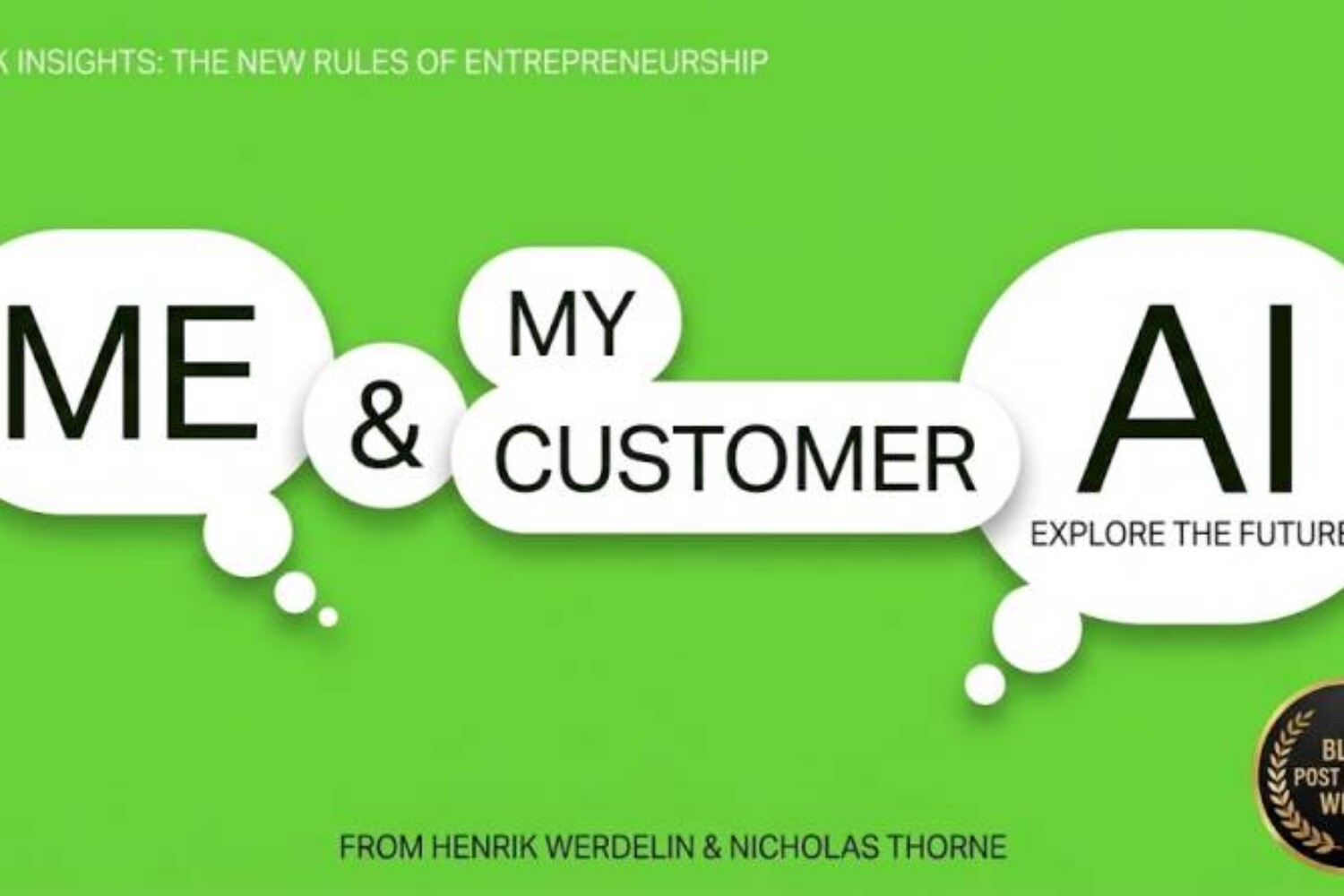
Me, My Customer, and AI by Henrik Werdelin and Nicholas Thorne is relevant because it places the customer back at the center of the AI conversation. The book is not simply about using AI to move faster. It is about using AI to build smarter, more customer-focused businesses without losing the human qualities that make entrepreneurship meaningful.
For founders, this is a very important distinction. AI can help us scale activity, but it cannot automatically create trust. It can help us generate ideas, but it cannot automatically choose the right problem. It can help us draft communication, but it cannot automatically understand the emotional reality of the customer. It can help us analyze data, but it cannot replace the founder’s responsibility to listen, interpret, and build with empathy.
In founder-led companies like ZAUQ Group, PHARMA TRAX, FOOD TRAX, and related ventures, this lesson is highly practical. We work in areas where customers do not only need products. They need confidence. A pharmaceutical company investing in traceability needs trust. A food company exploring digital verification needs clarity. A manufacturer using automation nee ds reliability. A customer adopting AI-enabled workflows needs reassurance that technology will improve work without damaging responsibility.
The central lesson from Me, My Customer, and AI is simple: AI should not move founders away from customers. Used well, it should help founders understand customers more deeply, serve them faster, and build more meaningful relationships at scale.
Summary and Detailed Insights
Me, My Customer, and AI explores how artificial intelligence changes the rules of entrepreneurship. AI can reduce the cost of experimentation, speed up market research, support prototyping, improve customer engagement, and help founders move from idea to execution more quickly. This makes entrepreneurship more accessible, but it also makes the market more crowded.
When more people can start faster, standing out becomes harder. The founder cannot rely only on speed, tools, or generic AI-generated output. The stronger advantage comes from combining AI capability with human insight: understanding the customer’s real problem, knowing which pain is worth solving, building trust, and creating a relationship that competitors cannot easily copy.
This is where the book becomes very relevant for practical founders. It asks us to clarify our entrepreneurial focus, identify who we are best positioned to serve, understand the customer’s real needs, and use AI as a co-pilot rather than a replacement for human thinking.
For founder-led companies, this is a useful correction. Many businesses rush into AI adoption by asking, “What can we automate?” That is a good question, but it is not the first question. The better first question is: “How can AI help us understand and serve the customer better?”
If AI only makes the company louder, faster, and more automated, it may create noise. If AI helps the company listen better, respond better, learn faster, and build deeper trust, it becomes strategic.
AI Lowers the Barrier, but Raises the Standard
AI makes it easier to start, but not necessarily easier to win.
This is an important founder reality. In the past, market research, branding, design, content, prototypes, customer communication, and software experiments often required more time, money, and specialized talent. Now, many of these first steps can be accelerated with AI. A founder can test more ideas, create more drafts, prepare more proposals, and explore more markets with less friction.
But when the barrier becomes lower for everyone, competition increases. Customers will see more offers, more content, more pitches, more tools, and more claims. They will become more selective. They will not reward companies simply for using AI. They will reward companies that solve real problems with clarity, credibility, and care.
This is why the founder must not confuse output with value. AI can increase output, but value comes from relevance. A customer does not care that we can produce more messages. The customer cares whether we understand their situation. A customer does not care that we can generate a proposal quickly. The customer cares whether the proposal reflects their real pain, constraints, risks, and desired outcome.
AI raises the standard because it removes excuses. If basic execution becomes easier, then the founder must compete on deeper insight, faster learning, stronger relationships, and better judgment.
The Customer Must Remain the Center
The title of the book is important: Me, My Customer, and AI. The order matters. It is not “AI, Me, and My Customer.” The founder and customer relationship remains central, and AI becomes the supporting capability.
This matters because many businesses become tool-centered. They adopt new software, dashboards, CRMs, automations, chatbots, content engines, and analytics tools, but slowly lose touch with the actual customer’s lived reality. They know more data, but understand less meaning. They communicate more often, but connect less deeply.
A founder must resist this. The customer is not a data point. The customer is a human being or organization dealing with pressure, risk, politics, timing, budget limitations, fear, hope, and internal constraints. AI can help reveal patterns, summarize conversations, and prepare better questions, but the founder must still show up with human attention.
For PHARMA TRAX, this is especially important. Customers dealing with serialization, regulatory compliance, and traceability are not only buying software. They are managing audit pressure, operational risk, production line realities, internal approvals, and fear of non-compliance. If we use AI only to generate sales content, we miss the point. If we use AI to understand customer objections, prepare better education, document implementation learnings, and respond faster with clarity, then AI strengthens trust.
 The customer must remain the reason for the technology.
Turning Trust Into a Competitive Edge
Trust becomes more valuable in an AI-saturated world.
When content becomes easier to generate, trust becomes harder to earn. Customers will see more automated messages, more AI-written articles, more polished proposals, and more confident claims. Some will be useful. Many will be generic. In such a market, the companies that win will be the ones customers trust.
Trust is built through understanding, consistency, honesty, delivery, and human responsibility. AI can support these things, but it cannot replace them. A company can use AI to remember customer history, summarize issues, improve follow-up, prepare support notes, and identify repeated concerns. But the customer will still judge whether the company is serious, reliable, and accountable.
For founders, this means AI should be used to improve trust systems. Customer follow-up should become more consistent. Support knowledge should become easier to access. Sales conversations should become better prepared. Implementation lessons should not be forgotten. Customer objections should be studied. Educational content should become more relevant. Internal handovers should become cleaner.
Trust is not created by one impressive meeting. It is created by repeated evidence that the company understands, remembers, responds, and delivers.
AI can help create that evidence if the founder designs it properly.
AI as a Co-Pilot, Not a Substitute for Founder Judgment
One of the strongest ideas in this book is the idea of AI as a co-pilot. This is a useful metaphor because it keeps responsibility in the right place. A co-pilot supports the journey, but the founder still owns the direction.
AI can help generate options, but the founder must choose. AI can summarize customer feedback, but the founder must interpret. AI can draft emails, but the founder must ensure tone, truth, and timing are right. AI can propose product ideas, but the founder must decide what fits the company’s strengths and customer reality. AI can accelerate research, but the founder must verify what matters.
This distinction is important because founders can make two opposite mistakes. One mistake is to avoid AI because it feels unfamiliar or threatening. The other mistake is to trust AI too much and allow it to replace thinking. Both are weak positions.
The mature founder uses AI actively but not blindly. He experiments with it, learns its strengths, notices its weaknesses, and builds review systems around it. He asks better questions because AI rewards better questioning. He develops better judgment because AI output still needs human evaluation.
In founder-led companies, AI should increase the founder’s leverage, not reduce the founder’s responsibility.
Clarifying Founder Energy and Direction
AI can help founders move faster, but speed is dangerous without direction. Before using AI to multiply activity, the founder must clarify what kind of business he is building, who he wants to serve, and where his own energy is best used.
This is an important reflection. Many founders are overwhelmed not because they lack tools, but because they lack focus. AI can actually make this worse. If the founder is unclear, AI can help produce more ideas, more documents, more campaigns, more products, and more distractions. The result may look productive, but the company becomes scattered.
The founder should first ask: what problems do we understand better than others? Which customers do we care about serving deeply? Where do we have unique experience? What kind of work gives us energy and credibility? What should we not pursue, even if AI makes it easier?
For ZAUQ Group, PHARMA TRAX, FOOD TRAX, and related ventures, this is very relevant. There are many possible AI use cases: sales, documentation, support, training, proposals, development, compliance education, content, customer onboarding, and internal knowledge. But not every use case deserves equal attention. The best starting points are those that strengthen customer trust, improve execution, and build long-term capability.
AI should help sharpen direction, not multiply confusion.
Building AI-Ready Organizations
An AI-ready organization is not simply a company with AI subscriptions. It is a company that knows how to learn, experiment, verify, document, and improve workflows.
This is very important. Many companies adopt tools but do not change the way work happens. Employees may use AI randomly, privately, or superficially. Some may avoid it. Some may overtrust it. Some may copy-paste outputs without judgment. Some may use it well, but their learning remains personal and does not become organizational capability.
A founder must build a more disciplined approach. The company should identify real workflows where AI can help. It should define what data can and cannot be used. It should train people on verification. It should create examples of good use. It should document use cases. It should encourage experimentation, but within responsible boundaries.
For example, a sales team can use AI to prepare customer briefs, but must verify the facts. A support team can use AI to draft troubleshooting notes, but must check technical accuracy. A marketing team can use AI to create first drafts, but must humanize them with real customer insight. A software team can use AI to assist coding, but must review, test, and secure the output. A leadership team can use AI for summaries and options, but must not outsource accountability.
 AI-readiness is not about excitement. It is about disciplined learning.
Keeping Customer Intimacy While Scaling
One of the biggest challenges in growing a company is keeping customer intimacy alive. In the early days, the founder often knows every customer personally. He understands their concerns, remembers their history, and can respond with context. As the company grows, this intimacy can weaken. Customers become accounts, tickets, records, or pipeline stages.
AI can either make this problem worse or help solve it.
If AI is used only for automation, customer communication may become faster but colder. Customers may feel processed rather than understood. However, if AI is used carefully, it can help teams remember context, summarize past interactions, identify unresolved concerns, personalize education, and prepare more thoughtful conversations.
The goal is not fake personalization. Customers can sense when a message is mechanically personalized but emotionally empty. The goal is informed human attention. AI should help the team know the customer better before speaking to them.
For trust-based businesses, this is a serious competitive advantage. A customer who feels remembered, understood, and supported is more likely to stay, expand, and refer. A customer who feels automated may look for another vendor who listens better.
The founder must therefore ask: are we using AI to make customer relationships more human, or only more efficient?
AI and the Founder’s Unique Advantage
AI will make many generic capabilities more common. Basic research, basic content, basic design, basic coding, and basic communication will become easier for more people. This means founders must become clearer about their unique advantage.
A founder’s advantage may come from industry experience, customer relationships, domain knowledge, market trust, operational understanding, cultural context, regulatory insight, execution history, or personal credibility. AI can support these strengths, but it cannot create them from nothing.
This matters because AI can tempt founders to enter areas where they have no real depth. Since AI can generate information on almost any topic, it may create the illusion of understanding. But customers with real problems can quickly sense shallow knowledge.
The stronger strategy is to apply AI where the founder already has context. AI plus domain depth becomes powerful. AI plus shallow understanding becomes risky.
For PHARMA TRAX, AI becomes useful because it can be combined with years of experience in pharma serialization, track and trace, production line realities, regulatory workflows, and customer implementation. For FOOD TRAX, it becomes useful when connected with real understanding of traceability, verification, consumer trust, and supply chain behavior.
AI amplifies what is already inside the organization. If there is real expertise, it can multiply it. If there is confusion, it can multiply confusion.
Founder Field Note
As a founder, I find Me, My Customer, and AI especially relevant because it speaks to the stage we are living through right now. AI is no longer a side topic. It is entering how we think, write, sell, develop, support, train, and lead. The question is not whether we should use it. The question is how we should use it responsibly and strategically.
In ZAUQ Group, PHARMA TRAX, FOOD TRAX, and related ventures, AI can help us move faster in many areas. We can create better customer education. We can prepare proposals more efficiently. We can document technical knowledge. We can improve support systems. We can summarize meetings. We can develop internal training. We can analyze customer objections. We can create content that explains complex ideas simply.
But the real purpose should not be speed alone. The real purpose should be better customer understanding and stronger trust.
Our customers are not buying AI-generated output. They are buying confidence that we understand their problem and can solve it responsibly. In pharma, food, automation, and compliance-related businesses, trust matters more than noise. AI should help us listen better, respond better, and remember better.
This book reminds me that the future belongs not to founders who simply use AI, but to founders who use AI while remaining deeply human.
Practical Founder Insight
The most useful founder lesson from Me, My Customer, and AI is that AI should be connected to customer intimacy, not only productivity. If AI only helps us produce more content, more messages, and more documents, it may create more activity without creating more value. But if AI helps us understand customer pain, identify patterns, personalize education, improve follow-up, and build trust, then it becomes a true competitive advantage.
For founders, this requires discipline. We must avoid AI theater. We must avoid generic output. We must avoid copying the same AI-generated voice as everyone else. We must protect originality, customer insight, and human judgment.
The founder should ask after every AI use: did this help us understand the customer better? Did it improve trust? Did it make our response more useful? Did it reduce confusion? Did it help us solve a real problem?
If the answer is yes, AI is serving the business. If the answer is no, AI is only adding noise.
 How to Apply Me, My Customer, and AI Today
 How to Apply Me, My Customer, and AI Today
Start With the Customer Problem
Before using AI for content, sales, product, or support, define the customer problem clearly. What pain are we solving? What risk does the customer face? What outcome matters to them? What fear or hesitation may be hidden beneath the surface?
Use AI to Listen Better
Feed AI with safe, appropriate, non-confidential customer notes, objections, FAQs, support patterns, and meeting summaries. Use it to identify recurring themes, unclear messages, common fears, and education gaps. The goal is not to replace listening, but to improve it.
Build Faster Experiments
Use AI to create quick drafts, mockups, prototypes, questions, and test plans. But treat these as starting points, not final truth. Let AI reduce friction so the founder can test with real customers faster.
Protect Human Review
Do not send AI output blindly. Review tone, accuracy, context, and customer sensitivity. In trust-based industries, careless automation can damage credibility quickly.
Create Customer Memory
Use AI-supported systems to help the team remember customer history, open issues, previous concerns, and promised next steps. Customer intimacy becomes stronger when the organization remembers what the founder used to remember personally.
Train Teams to Use AI With Judgment
AI literacy should become part of professional discipline. Teams should know how to prompt, verify, edit, personalize, and apply AI responsibly. They should also know what not to put into AI tools.
Keep the Founder Voice Human
When using AI for thought leadership or customer education, do not allow the content to become generic. Add real experience, specific observations, founder reflections, and customer realities. AI can help draft, but the founder must bring truth.
Key Ideas
• AI lowers the barrier to entrepreneurship but also increases competition.
• Technology alone will not create lasting advantage because more people can access similar tools.
• The customer must remain at the center of AI adoption.
• AI should be used to understand, serve, and support customers better.
• Trust becomes more valuable when AI-generated content and automation become common.
• AI should act as a co-pilot, not a substitute for founder judgment.
• Speed without direction can multiply distraction.
• AI-ready organizations require workflows, training, verification, and responsible boundaries.
• Customer intimacy must be protected as companies scale.
• AI becomes powerful when combined with real domain expertise.
• Founders must remain human, original, and responsible while using AI.
• The best AI use cases improve customer value, not just internal productivity.
Conclusion
Me, My Customer, and AI is a timely reminder that AI is changing entrepreneurship, but it should not change the core reason businesses exist: to solve real problems for real customers.
AI can help founders move faster. It can help us research, draft, prototype, analyze, document, and communicate with more leverage. But speed alone is not enough. In a world where tools become widely available, human understanding becomes more valuable.
The founder’s task is to use AI without losing customer intimacy. To scale without becoming cold. To automate without becoming careless. To move faster without becoming generic. To build with technology while remaining deeply human.
For founder-led companies, the opportunity is clear. AI can help us become sharper, faster, and more responsive. But only if we keep asking the most important question: how does this help us serve the customer better?
The question I am taking from this book is simple: am I using AI to create more output, or am I using it to build deeper customer trust and lasting value?