
What High Performers Often Overlook About Stress, Energy, and the Ability to Keep Showing Up
Introduction
There’s something strangely satisfying about being exhausted after a productive day. A full calendar, difficult decisions, problems solved, a workout completed, and perhaps a few more emails answered before going to bed.
We tell ourselves it’s been a good day because we’ve pushed hard.
But what happens when tomorrow demands the same effort? And the day after that?
As entrepreneurs, we’re accustomed to treating challenges as problems of discipline. When progress slows, we work longer. When commitments increase, we squeeze more into the day. When energy drops, we look for another productivity technique, another supplement, or another cup of coffee.
The assumption is that if we want better results, we must find a way to push harder.
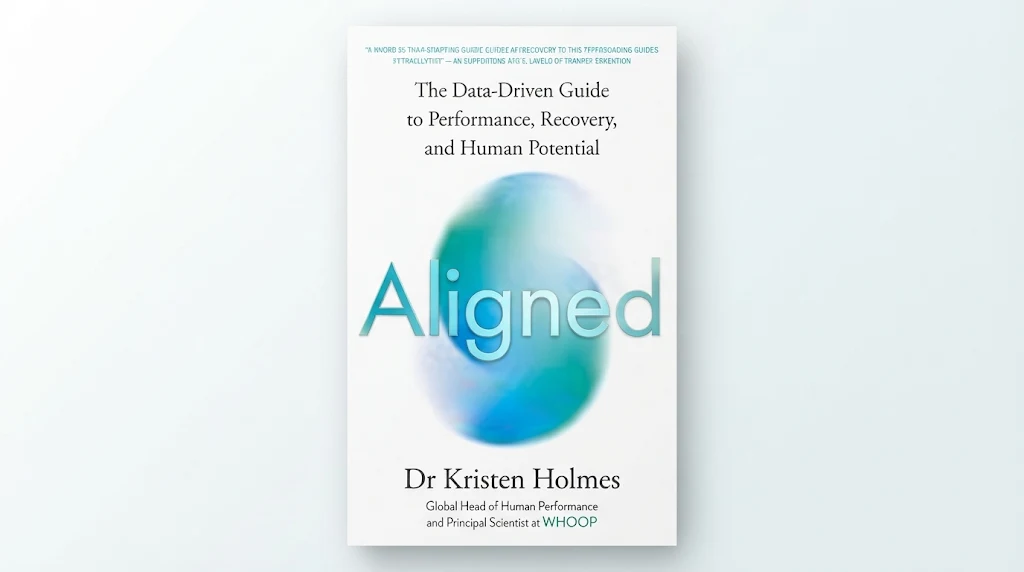
Aligned: The Data-Driven Guide to Performance, Recovery, and Human Potential by Dr. Kristen Holmes challenges that thinking.
Holmes has spent years working with athletes and studying human performance, including through her role at WHOOP. Her message is not that effort is unimportant. It’s that effort without adequate recovery eventually becomes counterproductive.
What makes the book particularly interesting to me is the connection between physical performance, emotional resilience, and the pressures of everyday life.
Whether we’re training for an ultramarathon, managing a growing company, or balancing professional ambitions with family responsibilities, the question isn’t simply how much we can accomplish today.
It’s whether we’re building the capacity to keep showing up tomorrow.

Stress Isn’t the Enemy. Constantly Running on Empty Is.
We often talk about stress as something we should eliminate. But Holmes makes an important distinction: stress is also how our bodies respond to challenges and adapt.
Physical training is a good example.
When we run, lift weights, or perform a demanding workout, we place stress on the body. Given appropriate recovery, the body adapts, potentially becoming stronger or more capable.
Without that recovery, increasing the workload may simply produce greater fatigue.
The same principle helps explain why a demanding professional life can sometimes feel energizing and sometimes completely overwhelming.
Holmes introduces a useful way to think about the relationship between demands and resources.
Our demands include everything requiring energy: work deadlines, financial pressures, difficult conversations, training, travel, and personal responsibilities.
Our resources include sleep, physical fitness, nutrition, emotional support, personal relationships, and the time available to recover.
When our resources are sufficient, we are better equipped to handle challenges. When demands consistently exceed those resources, our capacity can begin to deteriorate.
I find this framework more useful than simply asking whether I’m working too hard.
A difficult week doesn’t necessarily mean we need less ambition. It may mean we need to reconsider how we’re supporting that ambition.
Perhaps the workload is reasonable, but sleep has become irregular. Perhaps training intensity has increased while recovery has declined. Or perhaps professional obligations have expanded without leaving enough time for family, reflection, and ordinary life.
The solution isn’t always to remove every challenge.
Sometimes, it’s to strengthen the resources that help us meet them.

Your Biological Clock Doesn’t Care About Your Calendar
One of the book’s strongest themes is the importance of our circadian rhythm, the biological timing system that influences sleep, alertness, hormone activity, and other physiological processes.
Our bodies respond to signals such as daylight, darkness, meals, activity, and regular routines.
But modern life doesn’t always respect those rhythms.
We travel across time zones, attend late meetings, work under artificial lighting, use screens long into the evening, and expect ourselves to perform at the same level regardless of how we’ve slept.
Holmes argues that consistency in these daily patterns is an important foundation for sustained performance.
This doesn’t mean everyone must wake before sunrise or follow an identical schedule. People’s natural rhythms and personal circumstances differ.
What matters is creating a reasonably stable routine that supports sleep and recovery rather than constantly disrupting them.
This made me think about how easily professional obligations can shape our physical routines without our noticing.
A late meeting leads to a later dinner. A late dinner pushes back bedtime. Poor sleep makes the morning more difficult. The following day, we compensate with caffeine and attempt to maintain the same workload.
One disrupted night is usually manageable. But when irregularity becomes the routine, it can become harder to recover consistently.
The practical lesson is straightforward: instead of treating sleep as whatever time remains after completing everything else, we should consider it part of the foundation that enables everything else.
The Most Valuable Performance Metric Might Be Availability
One idea from Aligned that particularly caught my attention is what Holmes calls an availability reserve.
Imagine two runners preparing for the same race.
The first pushes every workout to the limit. Training sessions look impressive, weekly mileage keeps increasing, and every opportunity becomes another chance to demonstrate commitment.
The second trains consistently but balances challenging sessions with easier days, sufficient fueling, and recovery.
On an individual workout, the first runner might appear more dedicated.
But over several months, the runner who remains healthy enough to train regularly may build greater overall capacity.
Holmes emphasizes the importance of being available: not merely physically present, but sufficiently prepared and resilient to perform when needed.
This is a powerful way to think about performance because it changes what we value.
We naturally admire intensity. A particularly hard workout, an exceptionally long working day, or a difficult project completed under pressure makes a good story.
Consistency is less dramatic.
Nobody celebrates the ordinary night of sufficient sleep, the sensible decision to reduce training intensity, or the professional who takes a proper break before making an important decision.
Yet those ordinary choices may be what make sustained achievement possible.
For founders, availability matters just as much as it does for athletes.
A leader constantly operating at the edge of exhaustion may still attend every meeting and answer every message. But being present doesn’t automatically mean having the mental clarity, patience, and judgment those responsibilities deserve.
There is a difference between being busy enough to appear committed and being ready enough to perform well.
Recovery Is More Than Sleeping
When we hear the word recovery, most of us immediately think about sleep or taking a day off.
Those are important, but Holmes presents recovery more broadly.
It includes basic physical needs such as adequate food, hydration, and movement. It also includes opportunities to reduce stress, spend time outdoors, connect with people, and create space for reflection.
This is particularly interesting because the performance industry sometimes makes recovery look unnecessarily complicated.
There are cold plunges, specialized supplements, recovery devices, massage tools, breathing applications, and countless metrics promising to tell us how prepared we are.
Some of these tools may have benefits in specific circumstances, but the foundations remain remarkably ordinary.
Have we eaten adequately? Are we hydrated? Have we slept enough? Are we giving our bodies an opportunity to recover from training? Do we spend any meaningful time away from work-related pressure?
These questions aren’t particularly exciting, but they’re often more useful than searching for another advanced optimization technique.
I also appreciated the book’s discussion of breathing and the nervous system.
Periods of pressure can leave us physically tense and mentally alert even after the immediate challenge has passed. Gentle, controlled breathing may help some people settle and manage stress. Research supports breathing exercises as a potentially useful tool for reducing anxiety and stress, although they are not a substitute for appropriate medical or psychological treatment.
Holmes also explores how difficult past experiences can shape nervous-system responses. This reminds us that resilience isn’t simply a matter of telling ourselves to be stronger. Emotional health can be complex, and people sometimes need professional support rather than another self-improvement routine.
The broader message is that recovery is personal.
 Different people carry different demands, and the resources they need may not always be the same.
What Happens When Data Becomes Another Source of Pressure?
Because Holmes works closely with wearable technology and physiological data, this book offers an interesting complement to my previous reflection on Think Less, Sleep More.
Wearables can reveal patterns that are difficult to notice through memory alone.
Sleep regularity, resting heart rate, heart rate variability, training load, and other measurements can help us understand how our bodies respond to changes in routine and activity.
But data is useful only when interpreted sensibly.
A recovery score isn’t a complete assessment of physical or emotional well-being. Heart rate variability can fluctuate for many reasons, and a single reading shouldn’t determine every decision we make.
I believe there’s a valuable middle ground between ignoring data and becoming dependent on it.
If my running performance has declined while sleep has been irregular and training volume has increased, those patterns deserve attention.
But if I wake feeling reasonably well and my watch gives me a disappointing score, I shouldn’t automatically assume the day is lost.
Holmes’s approach encourages us to connect physiological information with actual behavior.
Instead of constantly asking what the numbers say, we can ask what they help us understand and what responsible action, if any, is needed.
The purpose of performance tracking should be better decisions, not more anxiety.
Founder Field Note: The Challenge of Managing Two Kinds of Endurance
This book feels especially relevant to the combination of entrepreneurship and endurance running in my own life.
Building and managing technology businesses requires sustained attention. There are customers to support, products to develop, teams to guide, financial responsibilities to manage, and emerging opportunities worth exploring.
The work rarely arrives in convenient, predictable intervals.
Something urgent can appear just when the day seems under control.
Running provides a different kind of challenge, but it also requires energy, discipline, and judgment.
My progression toward longer distances, including the Galiyat Mountain Trail 40K and subsequent endurance efforts, has taught me that motivation can sometimes outpace physical readiness.
It’s exciting to pursue a new milestone. The temptation is to train a little harder, add more distance, and assume the body will keep adapting.
But endurance isn’t built through effort alone.
Training must be balanced with recovery. And the stresses of professional life don’t disappear simply because we’ve changed into running shoes.
A challenging workweek followed by a demanding long run still places demands on the same body.
That’s perhaps the most useful idea I take from Aligned: we don’t have separate energy systems for business, running, family, and personal life.
All these responsibilities influence our overall capacity.
Technology helps me monitor aspects of that capacity, but the responsibility remains mine to interpret the information and make sensible choices.
I don’t want to become less ambitious about entrepreneurship or running.
I want to become more deliberate about maintaining the physical and mental resources that make those ambitions sustainable.
There’s also a leadership lesson here.
We often praise people who are constantly available, respond immediately, and take on every new responsibility. But perhaps we should pay more attention to whether our working culture allows people to perform sustainably.
High standards and recovery aren’t necessarily opposing ideas.
If we want teams capable of delivering consistently, we need working practices that respect human limits rather than treating exhaustion as evidence of commitment.
Five Practical Shifts I Want to Make
1. Review demands alongside resources. Instead of evaluating only my workload or training volume, consider whether sleep, nutrition, recovery, and personal time are keeping pace.
2. Protect a more consistent daily rhythm. Aim for sensible sleep and waking routines, while allowing realistic flexibility for travel, family, and professional commitments.
3. Train for long-term availability. Judge progress not just by demanding individual workouts, but by the ability to remain healthy and train consistently over time.
4. Use recovery data to guide, not dictate. Look for patterns across several days and combine them with how I actually feel, rather than reacting emotionally to every individual score.
5. Make simple recovery habits non-negotiable. Adequate fueling, hydration, mobility, time outdoors, supportive relationships, and moments away from constant stimulation deserve attention before expensive recovery innovations.
These aren’t dramatic changes. In fact, that’s what makes them useful.
Sustainable performance is often built through ordinary decisions repeated consistently.

Conclusion
Aligned by Dr. Kristen Holmes offers a perspective that ambitious people can easily overlook.
We tend to associate progress with doing more: longer hours, harder workouts, additional commitments, and increasingly demanding goals.
But greater effort doesn’t automatically produce better results.
Our ability to perform depends on how effectively we balance the demands placed on us with the physical, mental, and emotional resources available to meet them.
The book reminds us that sleep, recovery, movement, hydration, breathing, and supportive relationships aren’t distractions from achievement.
They help make achievement possible.
For founders and endurance athletes, this requires a different kind of discipline: knowing when to push, when to adapt, and when to give recovery the same respect we give hard work.
Perhaps real resilience isn’t the ability to operate indefinitely under pressure.
Perhaps it’s the ability to move between challenge and recovery without losing the capacity to enjoy what we’re working toward.
The question I’m taking from this book is simple: Am I building the capacity to sustain my ambitions, or am I gradually exhausting the very resources I depend on to achieve them?