
Introduction
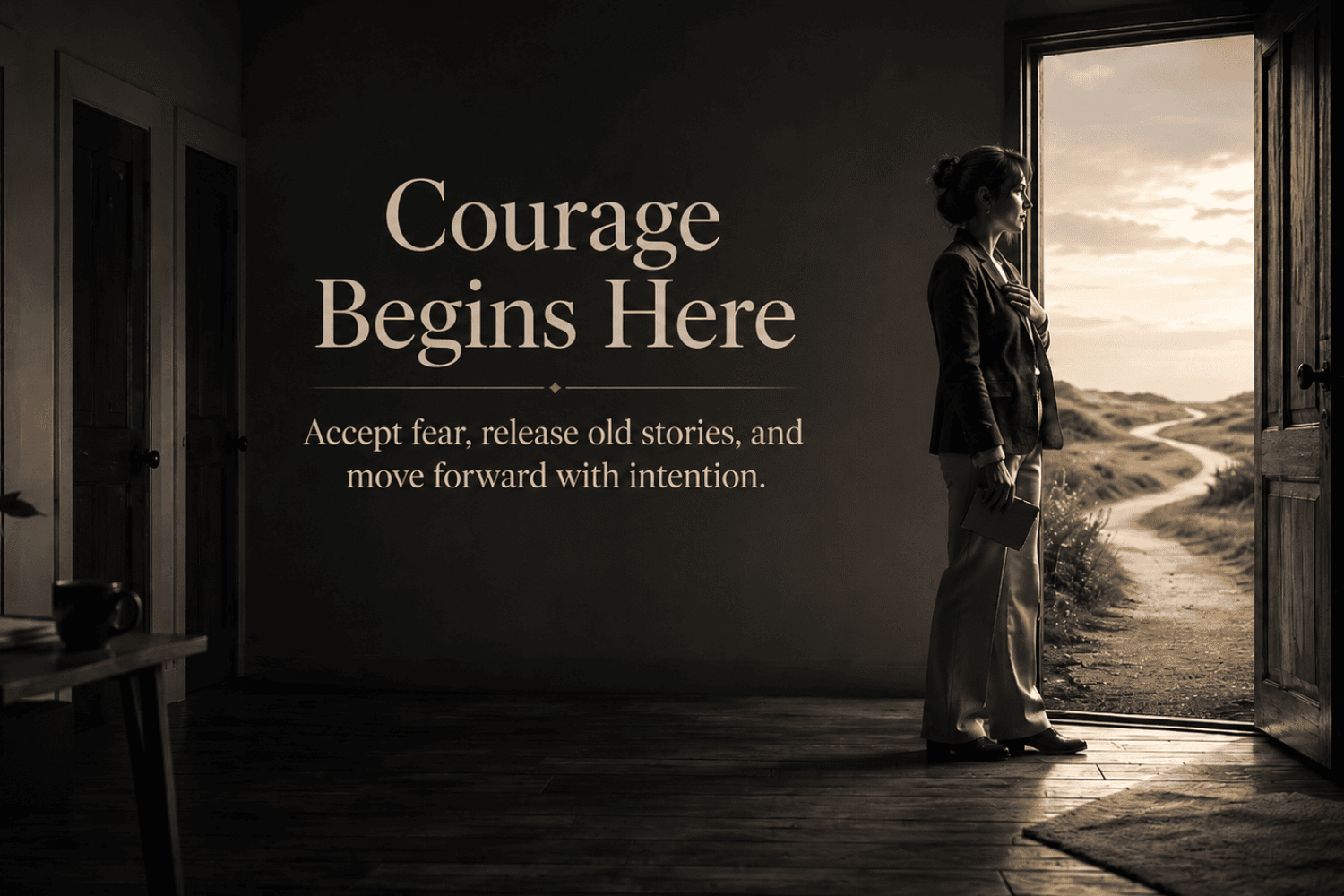
Learning how to build courage does not mean learning how to stop feeling afraid.
Fear is a normal response to uncertainty, change, rejection, risk, and possible failure. Therefore, waiting until fear disappears can keep a person stuck for years.
A difficult career decision may be delayed because starting again feels unsafe. Similarly, an honest conversation may be avoided because conflict feels uncomfortable. A creative idea may remain hidden because criticism seems too painful.
In The Courage Habit: How to Accept Your Fears, Release the Past, and Live Your Courageous Life, Kate Swoboda presents courage as a practice that can be repeated until it becomes more natural.
The official publisher describes the book as a practical program informed by cognitive behavioral therapy and acceptance and commitment therapy. Rather than telling readers to eliminate fear, the approach helps them recognize fear-based patterns and respond in a more useful way.
The central lesson is simple:
Courage grows when you stop treating fear as a command and start treating it as an experience you can understand.
Courage Begins by Recognizing Fear
Fear does not always look dramatic.
Sometimes, it appears as panic or visible anxiety. However, it may also appear as overthinking, perfectionism, delay, people-pleasing, self-doubt, or the need to control every possible outcome.
For example, a person may say:
- “This is not the right time.”
- “I need more qualifications first.”
- “I should wait until I feel certain.”
- “Other people will think I am selfish.”
- “I have already invested too much to change.”
- “I need the perfect plan before I begin.”
Some of these concerns may contain useful information. Nevertheless, fear can use reasonable language to protect an old routine.
The result is often temporary relief.
You avoid the conversation, delay the application, or remain in the familiar situation. As a result, anxiety falls for a short time.
However, the deeper problem remains.
Fear Can Become a Habit Loop
Habits often follow a simple pattern:
- A trigger appears.
- A familiar response follows.
- The response creates some form of relief or reward.
Fear-based habits can work in the same way.
For instance:
Trigger: You receive criticism.
Routine: You apologise quickly, withdraw, or change your opinion.
Reward: The immediate tension becomes smaller.
Another example might be:
Trigger: You consider sharing your work publicly.
Routine: You keep editing and never release it.
Reward: You avoid possible judgment.
Because relief follows the routine, the brain learns to repeat it.
Therefore, the habit becomes stronger even when it moves you away from what you truly want.
Common Fear Routines
Fear routines differ from person to person. However, several patterns appear often.
Perfectionism
You set an impossible standard so that the work never feels ready.
Although perfectionism may appear ambitious, it often protects you from criticism or failure.
People-pleasing
You focus on keeping everyone comfortable, even when doing so damages your own needs or values.
As a result, approval becomes more important than honest action.
Pessimism
You assume that effort will fail before it begins.
This may feel practical. However, it can become a way to avoid disappointment.
Self-sabotage
You delay, withdraw, or create problems near an important opportunity.
The behaviour may seem confusing, but it can protect you from the greater fear of being fully seen, tested, or responsible.
Recognizing the pattern is important because you cannot change a routine that remains hidden.
 Name What You Truly Want
 Name What You Truly Want
Courage becomes clearer when desire becomes honest.
Many people are better at describing what they should want than what they actually want.
They may follow a career because it appears respectable. They may remain in a role because others admire it. In addition, they may continue a lifestyle because changing direction would disappoint someone.
Fear often becomes stronger when a person’s true desire conflicts with expectations.
Therefore, ask:
- What do I want, apart from what looks sensible?
- What change keeps returning to my mind?
- Which part of my life feels false or restricted?
- What would I attempt if approval were not guaranteed?
- Which value am I failing to honour?
- What am I afraid to admit?
These questions do not mean that every desire should be followed immediately.
Responsibilities, consequences, and other people matter.
However, an honest desire can show the direction in which courage is needed.
Stop Trying to Eliminate Fear
A common response to fear is to fight it.
People tell themselves to be positive, become confident, stop worrying, or think differently.
Sometimes, these statements help briefly. However, fear often returns because the deeper experience has not been understood.
Swoboda’s official work argues that courage is not something a person must be born with. Instead, it can be practised by meeting fear with greater understanding rather than fighting, hiding, or pretending to feel confident.
Therefore, the better goal is not fearlessness.
The goal is to act with care even when fear is present.
This difference matters.
Fearlessness suggests that discomfort must disappear before action. Courage allows discomfort and action to exist together.
Notice Fear in the Body
Fear often appears in the body before the mind explains it.
You may notice:
- Tightness in the chest
- Faster breathing
- A tense jaw
- Heat in the face
- A heavy stomach
- Restless movement
- A sudden desire to escape
- Difficulty speaking clearly
These sensations can quickly lead to a familiar routine.
Therefore, one of the most useful steps is to pause and notice the body.
You might say:
- “My chest feels tight.”
- “My breathing has become shallow.”
- “My body is preparing to avoid this.”
- “Fear is present.”
This is different from saying:
- “Something terrible is happening.”
- “I cannot handle this.”
- “I must leave.”
The first group describes sensations. The second group adds a story.
By noticing the body, you create a small space between the trigger and the routine.
That space gives you a choice.
The Four-Part Courage Habit
Swoboda’s broader courage framework is built around four connected practices:
- Access the body
- Listen without attachment
- Reframe limiting stories
- Reach out and create community
Her official writing describes these as repeated actions that support psychological resilience and help people respond differently to fear.
1. Access the Body
First, slow down.
Notice your breathing, posture, heart rate, and physical tension.
You do not need to force the body to relax immediately. Instead, remain present long enough to recognize what fear is doing.
A simple practice is:
- Place both feet on the floor.
- Breathe slowly.
- Name three physical sensations.
- Notice the urge to escape or react.
- Wait before following that urge.
This practice helps interrupt automatic behaviour.
Moreover, it reminds you that fear is a physical experience, not always a reliable prediction.
2. Listen Without Attachment
Fear has a voice.
It may say:
- “You will fail.”
- “People will laugh.”
- “You are not ready.”
- “You cannot cope.”
- “You will regret this.”
- “Someone else has already done it better.”
Trying to silence this voice can make it louder.
Instead, listen without automatically believing it.
You might respond:
- “I notice the thought that I will fail.”
- “My inner critic is trying to protect me.”
- “This is a fear message, not a final fact.”
- “I can hear this thought without obeying it.”
Listening without attachment creates distance.
The inner critic can speak, but it no longer makes the decision.
3. Reframe Limiting Stories
A limiting story is an interpretation that has started to feel like truth.
For example:
- “I always ruin opportunities.”
- “People like me do not succeed.”
- “It is too late to change.”
- “I must make everyone happy.”
- “If I am criticised, I have failed.”
- “A brave person would not feel this afraid.”
Reframing does not mean replacing every difficult thought with a cheerful slogan.
Instead, it means searching for a wider and more accurate view.
For instance:
Old story: “If I make a mistake, everyone will lose respect for me.”
Reframe: “Some people may notice the mistake. However, I can take responsibility, learn, and continue.”
Another example:
Old story: “Changing direction means that all my earlier effort was wasted.”
Reframe: “My earlier experience may become part of the skills and knowledge I bring into the next stage.”
A useful reframe should feel believable.
It should open a possibility rather than deny reality.
4. Reach Out and Create Community
Fear often becomes stronger in isolation.
When a person struggles alone, anxious thoughts can begin to sound completely true.
Supportive people provide perspective, encouragement, practical help, and accountability.
Swoboda describes community as a core part of living courageously because relationships can make change feel more possible and help people face challenges they may avoid alone.
 A courageous community may include:
- A trusted friend
- A mentor
- A coach
- A colleague
- A family member
- A support group
- A professional community
- A therapist or qualified health professional where appropriate
The goal is not to find people who agree with every decision.
Instead, look for people who respect honesty, growth, responsibility, and courageous action.
How to Work with the Inner Critic
The inner critic often believes it is helping.
It warns you about rejection, embarrassment, failure, and uncertainty. In addition, it may repeat messages learned from earlier experiences.
If you attack the critic, the conflict can become more intense.
A calmer response is curiosity.
Ask:
- What are you afraid will happen?
- What are you trying to protect me from?
- When did I first learn this message?
- Is this danger current, or is it connected to the past?
- What would a wiser voice say?
- What small action is still possible?
This approach does not give the critic control.
Instead, it helps you understand the fear beneath the criticism.
Release the Past Without Denying It
 Release the Past Without Denying It
Past experiences shape present fear.
A painful failure may make new risks feel dangerous. Similarly, criticism from a parent, teacher, manager, or partner may continue to influence decisions years later.
Releasing the past does not mean pretending that it did not matter.
It means refusing to let an earlier experience become the only possible guide for the future.
For example:
- One failed business does not prove that every future idea will fail.
- One rejected application does not define your professional value.
- One damaged relationship does not make honest connection impossible.
- One period of low confidence does not become a permanent identity.
The past can offer information.
However, it does not need to control every new choice.
Courage Usually Begins with a Small Action
People sometimes imagine courage as one dramatic leap.
In reality, courageous change often begins with a small, clear step.
For example:
- Sending one email
- Asking one question
- Sharing one draft
- Applying for one opportunity
- Saying no to one request
- Setting one boundary
- Having one honest conversation
- Attending one supportive group
- Spending thirty minutes exploring a new direction
A small action teaches the brain that discomfort can be survived.
As a result, future action may become easier.
The purpose is not to choose the biggest possible risk.
Instead, choose the smallest step that still moves toward the truth.
Build Courage Through Repetition
Courage becomes a habit when the response to fear changes repeatedly.
The old pattern may be:
Fear → Avoidance → Temporary relief
A new pattern can become:
Fear → Pause → Notice → Reframe → Act → Seek support
The trigger may remain.
However, the routine changes.
Over time, the reward also changes. Instead of receiving only short-term relief, you begin to experience self-respect, learning, progress, and stronger trust in yourself.
A Practical Seven-Day Courage Reset
Day 1: Notice the pattern
Write down one situation in which fear regularly controls your behaviour.
Day 2: Name the desire
Describe what you truly want in that situation.
Day 3: Access the body
When fear appears, pause and identify the physical sensations.
Day 4: Hear the critic
Write down the exact message your inner critic repeats.
Day 5: Reframe the story
Create a more balanced and believable interpretation.
Day 6: Take one small action
Choose a step that feels uncomfortable but manageable.
Day 7: Reach out
Tell a trusted person what you are trying to change and what support would help.
Finally, review what happened.
The purpose is not to prove that fear has disappeared. It is to see whether you can respond differently.
How Leaders Can Build Courage at Work
 How Leaders Can Build Courage at Work
Courage also matters inside teams and organisations.
Employees may remain silent because they fear criticism, conflict, or damage to their careers.
As a result, leaders may not hear about problems until they become serious.
A more courageous work culture encourages people to:
- Question weak assumptions
- Admit mistakes
- Ask for help
- Share unfinished ideas
- Raise ethical concerns
- Give honest feedback
- Try responsible experiments
- Discuss failure without humiliation
However, leaders cannot demand courage while punishing every uncomfortable message.
They must respond with curiosity, fairness, and respect.
Otherwise, silence becomes the safer habit.
Who Should Read The Courage Habit?
The book is especially useful for:
- Professionals who feel stuck in an unfulfilling situation
- People considering a major life change
- Perfectionists who struggle to finish or share work
- People-pleasers who find boundaries difficult
- Creators and entrepreneurs afraid of criticism or failure
- Leaders who want to speak and act more honestly
- Anyone whose inner critic controls important choices
Its main value lies in making courage practical.
Instead of waiting for confidence, readers learn how to respond to fear in a different way.
About Kate Swoboda
Kate Swoboda is a writer, teacher, coach, and author whose work focuses on fear patterns, courage, personal change, and applied psychology.
She created Your Courageous Life and wrote The Courage Habit as a practical guide for turning courageous responses into repeatable behaviours. Her official site describes courage as something that can be practised rather than a quality that only certain people naturally possess.
Frequently Asked Questions
What is the main idea of The Courage Habit?
The main idea is that courage can be practised. People can learn to notice fear, change fear-based routines, reframe limiting stories, and act with support.
How can I build courage?
Start by identifying a fear routine. Then notice fear in the body, listen to critical thoughts without obeying them, create a more balanced story, and take one small action.
Does courage mean being fearless?
No. Courage means acting in line with your values even when fear or discomfort is present.
What is a fear routine?
A fear routine is a repeated response, such as avoidance, perfectionism, people-pleasing, or pessimism, that creates short-term relief but limits long-term growth.
How can I handle my inner critic?
Listen without automatically believing it. Ask what the critic is trying to protect you from, then choose a more accurate and useful response.
What does it mean to access the body?
It means noticing physical signs of fear, such as tightness, shallow breathing, tension, or restlessness, before reacting automatically.
Why is community important for courage?
Supportive people provide perspective, encouragement, accountability, and practical help. In addition, they reduce the isolation in which fear often becomes stronger.
Can courage become a habit?
Yes. When you repeatedly replace avoidance with awareness, reframing, action, and support, the new response can become easier and more natural.
Conclusion
Learning how to build courage begins with a change in how fear is understood.
Fear is not always proof that something is wrong.
Sometimes, it is the body reacting to uncertainty, change, visibility, or the possibility of rejection.
Therefore, courage does not require you to silence fear or pretend to feel confident.
First, notice the fear routine. Next, identify what you truly want. Access the body, hear the inner critic without obeying it, and reframe the story that keeps you stuck.
Then take one small action.
Moreover, do not try to create a courageous life alone. Supportive relationships make difficult change easier to continue.
A courageous person is not someone who never feels afraid.
Instead, it is someone who has practised a better response when fear appears.
Call to Action
Choose one area in which fear is shaping your choices.
Write down:
- What I truly want
- What triggers my fear
- What I feel in my body
- What my inner critic says
- What story I have been believing
- A more balanced interpretation
- One small action I can take
- One person I can ask for support
Then complete the smallest brave action within the next seven days.