
Introduction
Boards make decisions that affect employees, customers, investors, communities, and the future direction of entire organisations.
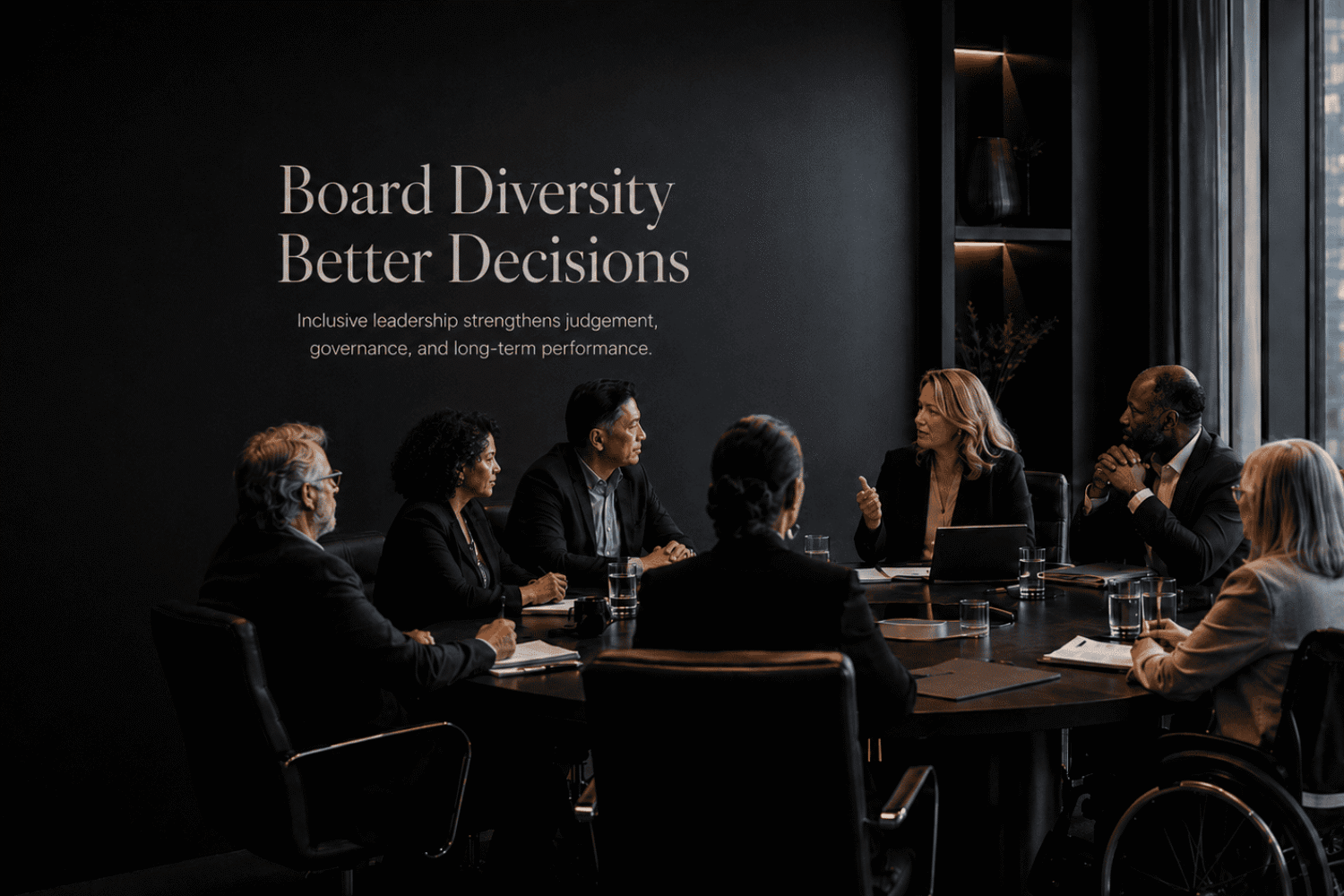
The quality of those decisions depends partly on the knowledge and judgment of individual directors. It also depends on whether the people around the table bring genuinely different experiences, perspectives, capabilities, and ways of thinking.
A board can contain accomplished professionals and still suffer from narrow thinking.
Members may have attended similar institutions, followed similar career paths, worked in the same industries, or developed comparable assumptions about risk and leadership. They may look different while approaching every issue in almost the same way.
In Difference Makers: A Leader’s Guide to Championing Diversity on Boards, Dr Nicky Howe and Alicia Curtis argue for a broader understanding of diversity. Their approach includes demographic, personal, and experiential differences and connects those differences with stronger problem-solving, innovation, and board performance.
The book’s central lesson is that representation alone is not enough.
A board must not only invite different people into the room. It must create the conditions in which their knowledge, questions, experiences, and disagreements can influence the final decision.
What Does Diversity Really Mean?
Diversity is often discussed through visible characteristics.
Gender, race, age, and physical ability are important dimensions of difference. They can shape how people experience institutions, opportunities, customers, and society.
However, visible characteristics do not tell the whole story.
Every person is also shaped by less visible influences, including:
- Education
- Professional background
- Industry experience
- Cultural upbringing
- Socioeconomic experience
- Personality
- Values
- Beliefs
- Cognitive style
- Disability or health experience
- Geographic background
- Family responsibilities
- Exposure to different markets and communities
This wider view prevents leaders from assuming that people who look similar will think alike or that people who look different will automatically contribute different perspectives.
Diversity of thought matters, but it should not erase representation
The idea of diversity of thought is valuable because boards need directors who notice different risks, question accepted assumptions, and interpret information from multiple perspectives.
However, diversity of thought should not become an excuse for ignoring demographic representation.
A board that claims to value different thinking while repeatedly recruiting from the same personal and professional networks may not be as open as it believes.
Visible, experiential, and cognitive diversity work together.
 A director’s thinking is influenced by what they have studied, where they have worked, the communities they understand, the barriers they have faced, and the responsibilities they have carried.
The official description of Difference Makers similarly presents diversity as a combination of experiential, personal, and demographic attributes rather than a single visible category.
Why Board Diversity Matters
Modern organisations operate in environments that are volatile, uncertain, complex, and difficult to predict.
Markets change. Technologies disrupt familiar business models. Customer expectations evolve. Workforces become more varied. Organisations may serve communities that are very different from the people sitting in the boardroom.
A board with limited perspectives may fail to see important changes until they become urgent.
Diverse boards can improve decision-making by bringing more questions into the discussion:
- How will different customer groups experience this decision?
- What risks are we overlooking?
- Which assumptions are based on past success?
- Who may be excluded by this policy?
- How might employees interpret this change?
- What alternative business models should we consider?
- Which stakeholder voices are missing?
Diversity does not guarantee that every decision will be correct.
It increases the range of information, experience, and interpretation available before the decision is made.
Better disagreement can produce better decisions
Board harmony is valuable, but harmony should not mean the absence of challenge.
When directors are too similar or when the culture discourages disagreement—the group may reach decisions quickly without examining alternatives thoroughly.
A productive board does not seek conflict for its own sake. It creates respectful tension around ideas.
Members should be able to question a proposal, identify risk, challenge assumptions, and offer an unpopular perspective without being treated as disloyal.
That kind of disagreement strengthens governance.
Bias Is a Major Obstacle to Board Diversity
Most leaders do not consciously intend to exclude capable people.
Yet recruitment and decision-making can still be influenced by patterns that favour the familiar.
Bias often appears through ordinary statements:
- “They are not the right fit.”
- “They do not have the traditional background.”
- “They need more board experience.”
- “We already have someone representing that perspective.”
- “I am not sure they would work well with the current group.”
- “Let us appoint someone we already know and trust.”
Some of these concerns may be legitimate. The danger is that vague language can hide unexamined assumptions.
Affinity bias
Affinity bias encourages us to feel more comfortable with people who resemble us in background, education, interests, communication style, or career experience.
Comfort can easily be mistaken for competence.
A candidate who communicates in a familiar way may seem more capable, even when another candidate brings more relevant knowledge.
Confirmation bias
Confirmation bias leads us to notice evidence that supports our first impression and overlook information that challenges it.
Once a board decides that a candidate is too inexperienced, too unconventional, or unlikely to fit, later information may be interpreted through that assumption.
Status quo bias
Status quo bias makes familiar arrangements feel safer than change.
A board may agree that diversity is important but continue using the same recruitment channels, selection criteria, and personal networks.
The desired outcome changes, but the process remains the same.
How Leaders Can Interrupt Bias
Bias cannot be addressed only by telling people to be more objective.
Boards need processes that make biased decisions harder to justify.
Useful practices include:
Define criteria before discussing candidates
Agree on the skills, experiences, stakeholder knowledge, and perspectives the board needs before reviewing individual names.
This prevents the criteria from being adjusted to favour a familiar candidate.
Broaden recruitment channels
If every director is found through the existing board’s network, the candidate pool will probably reproduce the board’s current composition.
Use professional associations, community organisations, governance programmes, industry groups, specialist recruiters, and open expressions of interest.
Use structured assessment
Ask candidates comparable questions and evaluate them against agreed criteria.
Unstructured conversations often reward confidence, familiarity, and similarity rather than relevant capability.
Challenge vague objections
When someone says a candidate is “not the right fit,” ask what that means.
Is the concern linked to an essential board requirement, or does the person simply communicate differently from existing members?
Record the reasoning
Document why candidates were shortlisted, rejected, or selected.
Clear reasoning makes it easier to identify patterns and improve future recruitment.
 Use Different Thinking Hats to Prevent Groupthink
 Use Different Thinking Hats to Prevent Groupthink
One practical way to improve board discussions is to ask members to examine an issue through different thinking perspectives.
Instead of allowing everyone to defend their initial position, the chair can deliberately change the question.
For example, the board might evaluate a proposal through five lenses:
Evidence
What facts do we have, and what information is missing?
Opportunity
What value could this idea create if it succeeds?
Risk
What could go wrong, and how serious would the consequences be?
Stakeholders
How would employees, customers, communities, regulators, or investors experience the decision?
Alternatives
What other options have we not considered?
This structured approach makes it easier for directors to explore views beyond their natural preferences.
A risk-focused director is invited to consider opportunity. An enthusiastic supporter must examine weaknesses. A financial discussion is widened to include people and reputation.
The objective is not to make every conversation longer.
It is to prevent the first confident opinion from determining the direction of the entire discussion.
Emotional Self-Awareness Improves Boardroom Judgment
 Emotional Self-Awareness Improves Boardroom Judgment
Boards are not purely analytical environments.
Directors bring emotions into the room, even when those emotions are hidden behind professional language.
A person may feel:
- Defensive because their proposal is being challenged
- Impatient because the meeting is running late
- Anxious about financial performance
- Frustrated with another director
- Overconfident after a recent success
- Embarrassed about missing important information
- Loyal to the executive who presented the recommendation
These emotional states can influence how evidence is interpreted and how disagreement is handled.
Recognising your mood creates an opportunity to manage it.
Pause before reacting
When a comment produces a strong emotional response, avoid replying immediately.
Ask yourself:
- What am I feeling?
- Why did this comment affect me?
- Am I defending the organisation, the idea, or my own status?
- Would I interpret this information differently in another setting?
- What question should I ask before reaching a conclusion?
Emotional awareness does not require directors to become less decisive.
It helps them distinguish thoughtful judgment from an automatic reaction.
Representation Is Not the Same as Inclusion
A board may appoint one person from an underrepresented group and still remain fundamentally unchanged.
This is the danger of tokenism.
Tokenism occurs when someone is present mainly to create the appearance of diversity rather than to hold genuine influence.
A tokenised director may be expected to:
- Speak for an entire demographic group
- Comment only on issues connected with their identity
- Be grateful for inclusion rather than challenge decisions
- Adapt completely to the existing culture
- Carry the organisation’s diversity agenda alone
True inclusion works differently.
An inclusive board values the director’s full professional capability. It gives them access to information, meaningful committee responsibilities, opportunities to lead, and the freedom to challenge established thinking.
Inclusion can be seen in the meeting process
Ask:
- Who speaks most often?
- Who is interrupted?
- Whose ideas are credited?
- Who receives information informally before meetings?
- Which directors are invited into influential committees?
- Does the chair actively request different perspectives?
- Can members disagree without social punishment?
- Do decisions change because different voices were heard?
These questions reveal whether diversity has become part of governance or remains a symbolic statement.
Frank Conversations Build More Inclusive Boards
 Frank Conversations Build More Inclusive Boards
Boards cannot improve diversity through policies alone.
They also need honest conversations about power, access, standards, and behaviour.
These discussions may feel uncomfortable because they challenge beliefs about merit and fairness.
Board members may need to examine:
- How current directors were recruited
- Which networks have historically been trusted
- Whether traditional criteria remain necessary
- Why certain candidates are described as risky
- How meeting behaviour affects participation
- Whether the chair protects dissenting voices
- Who has access to board-development opportunities
- Whether diversity goals carry real accountability
The purpose is not to shame existing directors.
It is to make invisible patterns visible enough to change.
A Seven-Step Framework for Building a More Diverse Board
Leaders can turn the book’s principles into a practical process.
1. Define what diversity means
Develop a board-level definition covering demographic, experiential, professional, and cognitive diversity.
2. Assess the current board
Review the board’s strengths, gaps, networks, stakeholder understanding, and patterns of similarity.
3. Identify future capability needs
Consider where the organisation is going, not only what has worked in the past.
The board may need knowledge of emerging technology, new markets, changing communities, workforce expectations, or regulatory developments.
4. Redesign recruitment
Use wider candidate sources and remove unnecessary requirements that favour traditional profiles.
5. Structure the selection process
Agree on criteria in advance, use comparable questions, and document decisions.
6. Build inclusive meeting practices
Give directors equal access to information, invite different viewpoints, manage interruptions, and encourage respectful challenge.
7. Review progress
Track appointments, participation, committee leadership, board culture, and the influence of different perspectives.
A diverse board is not created through one appointment.
It develops through repeated choices about recruitment, communication, leadership, and accountability.
Who Should Read Difference Makers?
The book is particularly relevant for:
- Board chairs responsible for board culture and appointments
- Directors who want to improve decision-making
- Chief executives working with boards and leadership teams
- Governance professionals designing recruitment and evaluation processes
- HR and diversity leaders supporting inclusion strategies
- Not-for-profit leaders seeking broader community representation
- Aspiring directors from underrepresented backgrounds
- Leadership facilitators and consultants working on board effectiveness
The official book description highlights practical personal strategies, board strategies, tools, templates, and real-life board experiences.
About the Authors
Dr Nicky Howe is a leadership and organisational-development professional whose work has focused on building the capacity of individuals, organisations, and communities. The official book material identifies her as an experienced chief executive and educator in business and management.
Alicia Curtis is the founder of Alyceum and works as a leadership facilitator, speaker, and community change-maker. Her official profile describes her work with purpose-driven leaders and organisations across Australia.
Together, the authors draw on their experience developing governance and leadership initiatives to present diversity as a practical board responsibility rather than an abstract aspiration.
Frequently Asked Questions
What is board diversity?
Board diversity is the inclusion of directors with different demographic characteristics, professional skills, life experiences, cultural perspectives, cognitive styles, and stakeholder knowledge.
Why is diversity of thought important?
Diversity of thought helps boards challenge assumptions, identify overlooked risks, understand more stakeholders, and consider a wider range of possible solutions.
Is diversity of thought enough by itself?
No. Diversity of thought should complement rather than replace demographic and experiential representation. A board cannot claim broad thinking while repeatedly recruiting from the same narrow networks.
How does bias affect board recruitment?
Bias can cause boards to favour familiar candidates, traditional career paths, similar communication styles, and existing professional networks even when other candidates offer valuable capabilities.
What is group think in a boardroom?
Group think occurs when the desire for agreement or harmony discourages members from questioning assumptions, raising concerns, or presenting alternative options.
What is tokenism?
Tokenism is the symbolic inclusion of a person from an underrepresented group without giving them meaningful influence, support, access, or authority.
How can a board become more inclusive?
Boards can improve inclusion by broadening recruitment, setting clear selection criteria, distributing information equally, inviting different perspectives, managing interruptions, and reviewing who influences decisions.
What role does the board chair play?
The chair shapes meeting culture. They can invite quieter voices, protect respectful disagreement, challenge vague objections, prevent domination, and ensure diverse perspectives affect decisions.
Conclusion
Diversity is not achieved simply by placing different faces around a boardroom table.
It requires leaders to examine who gains access, how candidates are evaluated, whose voices influence decisions, and whether the board is willing to question its own assumptions.
Difference Makers offers a practical reminder that diversity is both a leadership responsibility and a governance advantage.
Boards become stronger when they broaden the experiences available to them, interrupt bias, prevent group think, manage emotions, reject tokenism, and create room for frank conversation.
The objective is not diversity for appearance.
It is better leadership through wider participation, stronger challenge, and more informed decisions.
A board becomes genuinely diverse when difference is not merely present but respected, heard, and allowed to shape what the organisation does next.
Call to Action
At your next board or leadership meeting, ask three questions:
- Which important perspective is missing from this discussion?
- Which assumption have we accepted without testing?
- Whose voice has not yet influenced the decision?
Then review your next board appointment process before the search begins.
Define the capabilities, experiences, and perspectives the organisation genuinely needs and expand the candidate pool accordingly.