
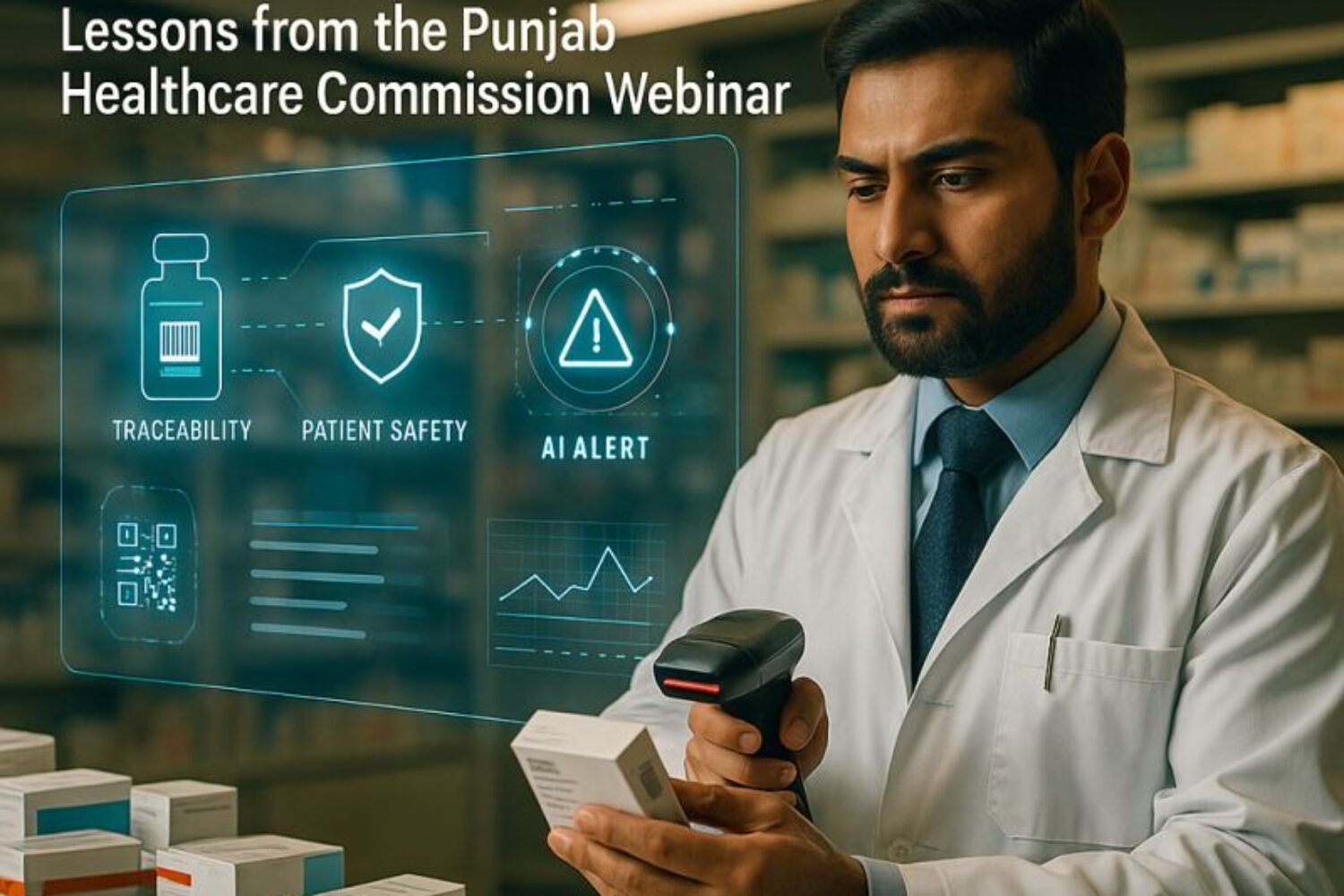
Making Medication Safer for Every Patient: Lessons from the Punjab Healthcare Commission Webinar
When we talk about healthcare quality, patient safety remains the central promise — yet one of its most persistent challenges continues to be medication errors.
During the World Health Organization’s Patient Safety Week (3–9 Nov 2025), the Punjab Healthcare Commission (PHC) gathered regulators, educators, clinicians, and pharmacists to discuss one powerful theme:
“We Can All Help Make Medication Safe.”

A Regulator’s Lens: The Scale of the Challenge
Speaker: Dr. Muhammad Saqib Aziz, CEO – PHC

- As per WHO 2022, 1 in 20 hospitalized patients suffer harm from medication errors. www.who.int
- 42.7 million adverse events occur each year worldwide — ranking among the top 3 causes of death in advanced health systems.
- Half of these are preventable.
In Pakistan, weak enforcement, self-medication, and workforce shortages amplify the risk.
PHC has inspected 200,000+ illegal outlets and sealed 40,000 quackery setups, yet counterfeit dispensing and untrained prescribing persist.
 A simple labeling issue — two similar saline bottles mistaken during antibiotic infusion — tragically cost lives.
“Something as small as a label can decide whether a patient survives or not,” Dr. Saqib noted.
Mapping the Medication-Safety Ecosystem
Speaker: Dr. Umar Rashid, Additional Director (QA & M&E, PHC)
He mapped the full chain of responsibility: DRAP → MOH → Provincial Health → Manufacturers → Hospitals → Public → Media.
Medication safety fails not only due to system gaps but because information doesn’t flow.
Key Recommendations
- Create a National Formulary like the British National Formulary.
- Standardize prescription formats (refill + dispense fields).
- Publish a notified OTC list to curb self-medication.
- Make drug-alert compliance part of hospital evaluations.
Clinical Governance and Culture Change
Speaker: Prof. Khalid Masud Gondal, President CPSP & VC Fatima Jinnah Medical University

“Medication errors are not acts of negligence — they are failures of systems.”
He advocated for:
- Electronic prescribing and bar-coded drug administration.
- Non-punitive reporting to encourage learning.
- Integration of patient-safety training in all medical curricula.
- National KPIs for Medication Safety to measure progress.
Children Are Not Small Adults
Speaker: Prof. Masood Sadiq, VC University of Child Health Sciences

Nearly half of Pakistan’s population is under 18. Pediatric errors are three times more frequent than adult ones.
Critical Challenges
- Weight-based dosing errors and decimal-point mistakes.
- Off-label use of adult formulations (aspirin → Reye’s Syndrome).
- Parents using household spoons for syrups.
- Lack of child-friendly formulations.
Action Points
- Establish a National Pediatric Formulary.
- Mandate pictorial instructions for caregivers.
- Deploy clinical pharmacists in pediatric wards.
- Encourage barcode verification for pediatric dosing.
The Cost of Miscommunication
Speaker: Dr. Asim Rauf, Former CEO DRAP
Dr. Asim Rauf

Weak communication and incomplete handovers silently drive thousands of preventable tragedies.
Globally, such failures cost USD 40 billion annually.
Examples
- Unmonitored warfarin dose → fatal bleeding.
- Missed sedative withdrawal → patient death.
He promoted the SBAR model (Situation–Background–Assessment–Recommendation) to structure clinical dialogue and proposed leveraging AI + digital traceability to flag drug interactions and dose errors automatically.
Human Factors: Beyond Blame
Speaker: Dr. Haroon Hafeez, Director Quality & Patient Safety, Shaukat Khanum Hospital

“Human error is inevitable — system design is preventable.”
Key Insights
- Each interruption increases medication-error risk by 12.5%.
- Four interruptions = double the likelihood of harm.
- Introduce “Do Not Disturb” drug-round policies and smart infusion pumps.
- Promote Just Culture — accountability with empathy, not fear.
 Pharmacovigilance and the Future of Traceability
Speaker: Dr. Zahid Hassan Nansab, Additional Director – DRAP Punjab Office
- Pakistan joined the WHO Global Drug Monitoring Program in 2018. www.dra.gov.pk
- DRAP launched the Med Safety App and VigiFlow Portal for ADR reporting.
- Pharmacovigilance Rules 2022 formalized mandatory reporting. Drug Regulatory Authority In Pakistan
- 2D Barcode Pilot now tracks antimicrobial medicines from factory to pharmacy.
“Traceability is no longer optional; it is the foundation of patient safety.”
Shared Responsibility, Shared Future
Medication safety is not the duty of one institution — it is a national ecosystem effort.
As Dr. Saqib Aziz concluded, culture change requires collaboration between regulators, academia, industry, and the public.
“It is not the responsibility of one person or one stakeholder. It is the responsibility of all of us.”
Why This Conversation Matters
For innovators working in healthcare digitalization, this webinar marked a turning point.
At PHARMA TRAX, we see traceability as more than compliance — it is a patient-safety infrastructure.
When every pack carries a digital identity, every error becomes traceable and every recall becomes measurable.
Medication safety begins with awareness, but it matures with visibility.
 When every dose is traceable, every error is teachable, and every life becomes safer.
Key Takeaways
- 50 % of medication errors are preventable.
- Pakistan needs a National & Pediatric Formulary.
- Traceability + Communication + Culture = Safety.
- Build a Just Culture, not a blame culture.
- Combine AI and serialization for predictive safety.